Laser hair removal has become a popular cosmetic procedure for many individuals seeking a long-term solution to unwanted hair. But have you ever wondered why some lasers work better for certain skin types than others? Or why some people are advised against laser hair removal altogether? The answer lies in the Fitzpatrick Scale, a classification system for skin types. Understanding this scale is crucial for both practitioners and clients to ensure the best results and avoid potential complications.
The Fitzpatrick Scale, which we’ll delve into more deeply in the next section, categorizes skin types based on their reaction to sun exposure. It’s not just about the color of the skin; it’s about how the skin responds to UV light. For those on the lower end of the Fitzpatrick Scale, choosing the right laser is paramount. Why? Because the wrong laser can lead to burns, hyperpigmentation, and other unwanted side effects.

Now, if you’re a lower Fitzpatrick client or someone with a lighter skin tone, you might be wondering: “What’s the best laser for me?” Well, that’s the golden question, and this article aims to provide a comprehensive answer. We’ll explore the different types of lasers available, their pros and cons, and how to determine which one is the best fit for your unique skin type.
But before we dive into the nitty-gritty of lasers and the Fitzpatrick Scale, let’s take a moment to appreciate the science behind laser hair removal. Imagine a beam of light targeting the pigment in your hair follicle, heating it up, and thereby inhibiting future hair growth. It’s like using sunlight to burn a piece of paper through a magnifying glass, but much more precise and controlled. This precision is what makes laser hair removal so effective, but it’s also why choosing the right laser for your skin type is so essential.
In the upcoming sections, we’ll demystify the Fitzpatrick Scale, introduce you to the world of lasers, and guide you on your journey to smooth, hair-free skin. So, are you ready to embark on this enlightening journey?
Understanding Fitzpatrick Skin Types
The Fitzpatrick Scale, developed by Thomas Fitzpatrick in 1975, is a classification system for skin types based on their reaction to ultraviolet (UV) light. It’s a tool used by dermatologists and laser technicians to determine the risk of sunburn and potential for skin damage.
| Aspect | Description |
|---|---|
| Introduction to the Fitzpatrick Scale | The Fitzpatrick Scale is a classification system for skin types based on their reaction to UV light. |
| What is the Fitzpatrick Scale? | The scale categorizes skin types into six categories, ranging from Type I (very light, always burns, never tans) to Type VI (very dark, never burns, always tans). |
| Type I | Often characterized by very fair skin, red or blonde hair, and blue or green eyes. This skin type always burns and never tans. |
| Type II | Fair-skinned, often with blonde or light brown hair and blue, green, or hazel eyes. This skin type usually burns and tans minimally. |
| Type III | Cream white to light brown skin tone, often with any hair or eye color. This skin type sometimes burns but tans uniformly. |
| Type IV | Moderate brown skin, typically tans easily and rarely burns. Often associated with Mediterranean, Asian, or Hispanic backgrounds. |
| Type V | Dark brown skin, which very rarely burns and tans easily. Common among some Asian, Middle Eastern, and African backgrounds. |
| Type VI | Deeply pigmented dark brown to black skin. It never burns and tans very easily. |
| Importance in Laser Hair Removal | The Fitzpatrick Scale is essential in laser hair removal because it helps practitioners select the right laser and settings for each client. |
Types of Lasers for Hair Removal
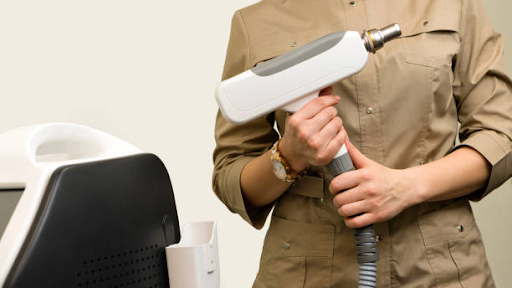
Laser hair removal technology has evolved over the years, leading to the development of various lasers tailored to different skin types and hair colors. Here are the three primary lasers used in hair removal:
- Alexandrite Laser
- Wavelength: This laser operates at a 755 nm wavelength.
- Suitability: Best suited for Fitzpatrick skin types I to III. It’s effective for lighter skin tones with dark hair.
- Advantages: It offers a rapid treatment time and is highly effective for finer hair types.
- Disadvantages: There’s a higher risk of burns or discoloration on darker skin tones.
- Nd:YAG Laser
- Wavelength: This laser operates at a 1064 nm wavelength.
- Suitability: It’s the safest option for darker skin types, typically Fitzpatrick types IV to VI.
- Advantages: It can treat a broader range of skin types and has a deeper penetration.
- Disadvantages: It might be less effective on fine or light-colored hair.
- Diode Laser
- Wavelength: This laser operates at an 800-810 nm wavelength.
- Suitability: It’s versatile and can treat Fitzpatrick skin types I to IV effectively.
- Advantages: It combines the best of both the Alexandrite and Nd:YAG lasers.
- Disadvantages: There’s a moderate risk of burns or discoloration if not used correctly.

Choosing the Right Laser for Lower Fitzpatrick Clients
When it comes to selecting the best laser for hair removal, especially for lower Fitzpatrick clients, there are several factors to consider:
- Skin Type: Lighter Skin (Types I-III) benefits from Alexandrite and Diode lasers. Medium Skin (Type IV) often finds the Diode laser to be the best choice.
- Hair Color and Texture: Dark and Coarse Hair can be effectively targeted by all three lasers, while Light or Fine Hair often sees better results with the Alexandrite laser.
- Safety and Efficacy: Always prioritize safety. Ensure the practitioner is experienced and knowledgeable about the Fitzpatrick Scale. While safety is paramount, you also want results. Ensure the chosen laser is not only safe but also effective for your skin type and hair color.
Benefits and Risks of Laser Hair Removal
Benefits
Laser hair removal offers:
- Long-Term Results: More permanent results compared to shaving or waxing.
- Precision: Lasers can selectively target dark, coarse hairs without damaging the surrounding skin.
- Speed: Each laser pulse takes a fraction of a second.
- Cost-Effective: In the long run, individuals save money compared to other hair removal methods.
Risks and Side Effects
Potential risks include:
- Skin Irritation: Temporary discomfort, redness, and swelling.
- Pigment Changes: Temporary darkening or lightening of the skin.
- Rare Side Effects: Blistering, scarring, or changes in skin texture.
In a nutshell
Laser hair removal is a revolutionary procedure that offers a long-term solution to unwanted hair. For lower Fitzpatrick clients, understanding the intricacies of the procedure is crucial. By being informed and choosing the right laser for your skin type, you can enjoy the benefits of smooth, hair-free skin while minimizing potential risks. Always consult with a seasoned professional before undergoing any laser hair removal procedure.

FAQs
- What is the recovery time after a laser hair removal session?
Typically, there’s no extended recovery time. You might experience redness or swelling, but these symptoms usually subside within a few hours. It’s advised to avoid sun exposure and wear sunscreen to protect the treated areas.
- How many sessions are required for optimal results?
On average, individuals require 4-6 sessions spaced 4-6 weeks apart. However, this can vary based on hair color, hair type, and skin type.
- Is the procedure painful?
Most people compare the sensation to a rubber band snapping against the skin. While not entirely pain-free, it’s generally more comfortable than waxing.
- Can I shave between laser hair removal sessions?
Yes, you can. In fact, it’s recommended to shave a day before your treatment. However, avoid waxing or plucking as these methods remove the hair from the follicle, which is the target of the laser.
- Are the results of laser hair removal permanent?
Laser hair removal significantly reduces hair growth. After the initial set of sessions, some people might require periodic maintenance treatments. However, the hair that grows back is often finer and lighter in color.